
Vitals and Other Signs of Life by David A. Goodrum
The Poetry Box, 2024, 108 pages, $18
ISBN 978-1-956285-63-5
Available at https://thepoetrybox.com/bookstore/vitals
David A. Goodrum’s debut collection, Vitals and Other Signs of Life, moves with the quiet awareness of someone slightly set apart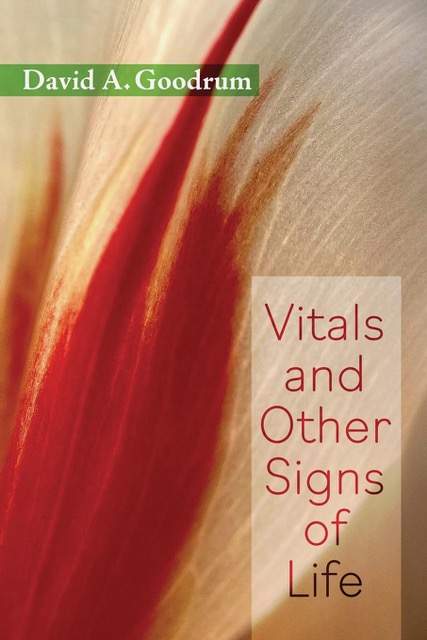 —present in the room, or out in nature, but observing from the edges. These poems return to memory not for nostalgia, but to trace the subtle signals of a life shaped more by watching than speaking. Goodrum seems attuned to this double stance—both participant and observer—which opens into what he calls double vision: an internal gaze informed by reflection, and an outward gaze that stays just at the edge of things. He writes with a gentle willingness to look without judgment that deepens the quiet attention running through the collection. As he writes in the poem ,“Letter of Introduction,” …I offer double vision… My green eyes, when closed / and pressed, reveal nebula stars… I am a spotted towhee asleep in the dark.
Structured in three sections, the collection traces an inward journey. The opening section, Vitals, grounds the reader in defining experiences—childhood memory, illness, family rupture—where the speaker begins to question the shape of a life. In the second section, Fully Aware of the Falling Fistfuls of Dirt Still to Follow, the poems confront aging and the passing of time. By the final section, Somewhere Between the Sleep of Roiling Water and the Sleep of Ice, the speaker moves through shifting landscapes—both natural and internal— quietly unfolding into a different sense of self. While reading, I felt the urge to brace myself, anticipating the poet’s tight radius turns, vital for his survival, as if he is navigating switchbacks up the side of a mountain
In the dramatic first poem, “My Brother Jumped from the Fire,” Goodrum imagines his brother’s experience as his own. He constructs the real-life moment when his brother was trapped in a burning building and envisions himself leaping from a three-story window. Goodrum writes: …but my brother knew he had to / pack up the cleaning… knew he had to drive his daughter / to flute practice… knew this weekend / the garden had to be started. This stark contrast between the extraordinary and the ordinary underscores the speaker’s urgency to survive, even as everyday obligations persist in the mind.
Goodrum explores his subjects through varied poetic forms and structures. “What We Bring to the Ocean” has an irregular pattern and uneven lines to evoke the ocean’s vastness and uncertain nature with language mimicking its subject.
On our approach
the growing sounds
of white crested waves whomping
distant outcrops
so much w i n d b l o w n s a n d…
I especially appreciate the breathing space within this poem, where thought and description seem to rise above the page. This use of spaciousness not only reinforces the speaker’s emotional state of mind but also allows us to engage with elements of the natural world—elements that become most prominent in the collection’s third section.
In “Lightheaded Near Yaquina Head,” also a nature poem, Goodrum writes of his relationship with the sea: If I stay much longer I’ll soon be sand-covered / like a lost penny in need of a detector to be found. The speaker waits for old footprints to fly away, an image that lingers like the sea itself.
The opening lines of “Fear of Water” are visceral and laden with unspoken tragedy, in a way that resonates with W. H. Auden’s conviction: “Poetry…may express every possible shade of emotion, and describe every conceivable kind of event, but there is only one thing that all poetry must do; it must praise all it can for being and for happening.”[1] Goodrum’s poem begins: That day. The toddler who didn’t / know. The poet goes on to say: I listen to the dragging pass / and fail; watch the men recoiling / the ropes…We are out here to reclaim him. The final lines reflect on the fragility of life:
For he began
with the breaking
of water. Then the shift of bone
over bone until his head crowned
shaped like a cone. And thereafter
water refusing to ever
fully support him again.
Even in the face of the child’s brief life and tragic drowning, the poet gives praise for the child’s birth, simply for being and for happening.
Vitals and Other Signs of Life offers an insightful, intimate journey through a life that will resonate with many readers. Goodrum’s voice is sincere, humorous, and sad all at once. The poems swerve into meaning beneath a surface of emotional control that ultimately gives way to raw honesty and offers cautionary wisdom drawn from lived experience.
Reviewer’s Bio
Colleen Reader is a graduate of Warren Wilson College’s MFA program. Reader’s poems have appeared in the anthology Up from the Soles of Our Feet, the national publication The MacGuffin, and the Bellevue Literary Review, in which she took third-place for her poem “Invisible.”
- WH Auden, “Making and Judging Poetry,” The Atlantic Monthly. January 1957. ↑